
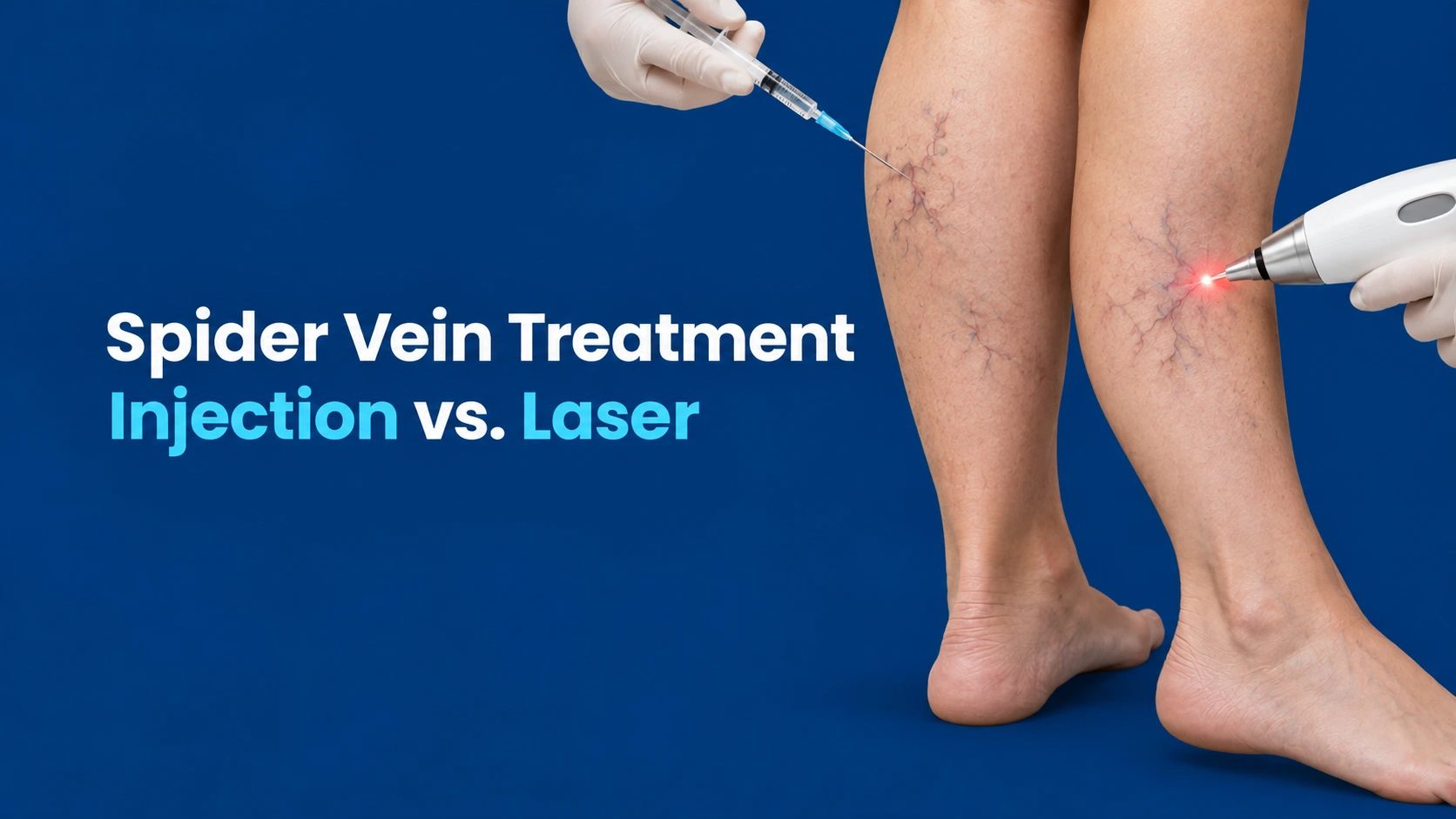
For leg spider veins, sclerotherapy is commonly used as a first-line treatment, while surface laser treatment can be useful for selected very small superficial vessels or when injections are not suitable. Neither treatment is universally better for every patient. The right treatment depends on the size, location, depth, and pattern of the veins, as well as the treatment area and patient-specific factors.
Texas Vein Experts currently uses compounded sclerotherapy for eligible spider veins, reticular veins, and selected small varicose veins. Surface laser is discussed in this article as an educational comparison, but it is not listed among TVE’s four current treatment options.
What Is Sclerotherapy for Spider Veins?
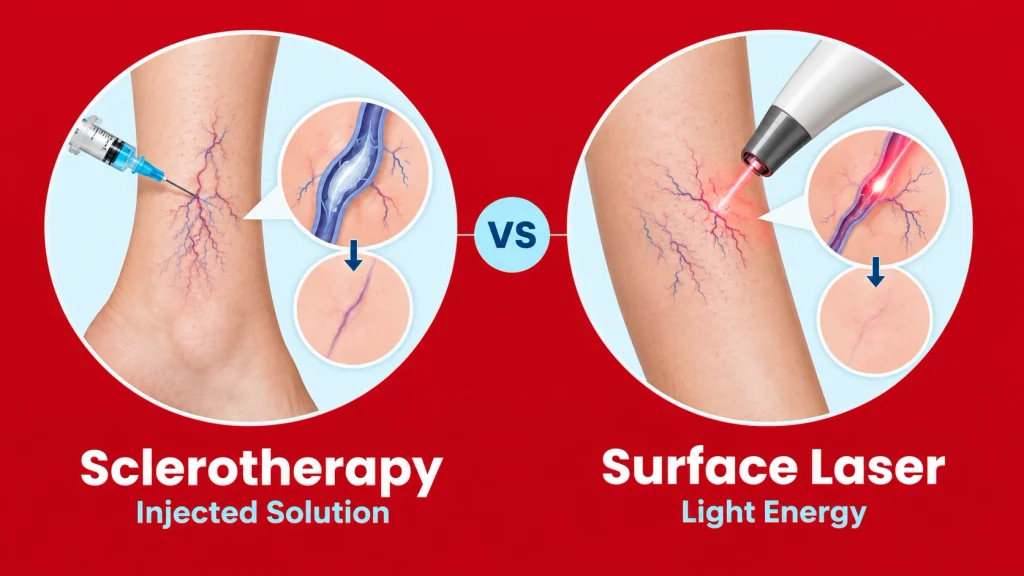
Sclerotherapy is an injection treatment for small surface veins. A vein specialist injects a sclerosant into the target vein. The medication irritates the inner vein wall, causing the treated vein to close. Blood naturally redirects through healthier veins, and the closed vessel gradually becomes less visible over time.
TVE uses compounded sclerotherapy for spider veins, reticular veins, and eligible small varicose veins. The treatment plan depends on the veins being treated, the size and distribution of the visible vessels, previous treatment, symptoms, and clinical findings. It is a minimally invasive treatment and does not require a surgical incision.
How Does Laser Treatment for Spider Veins Work?
Surface laser treatment uses light energy delivered through the skin to heat and close selected small visible vessels. Unlike sclerotherapy, it does not require an injection into each target vein. Laser therapy may be considered for very small superficial vessels, selected facial veins, or patients for whom injections or a sclerosant are not suitable.
Surface laser treatment for spider veins should not be confused with endovenous laser ablation. Endovenous laser ablation is a catheter-based thermal procedure used inside certain larger refluxing veins. It serves a different purpose from laser spider-vein treatment at the surface of the skin.
Sclerotherapy vs. Laser: What’s the Difference?
Both treatments are designed to make visible problem veins fade, but they reach the vein differently and may fit different vessel patterns.
| Factor | Sclerotherapy | Surface Laser |
| How treatment works | Injection places sclerosant inside the target vein | Light energy is delivered through the skin |
| Common use | Leg spider veins and reticular veins | Very small superficial vessels; selected facial veins |
| Needles | Yes | No injection into the target vein |
| Reticular veins | Commonly treated when clinically appropriate | May be less suitable depending on vein size and depth |
| Sessions | More than one treatment session may be needed | Multiple laser sessions may be needed |
| Results | Treated veins fade gradually | Treated vessels fade gradually |
| Downtime | Usually minimal | Usually minimal |
| TVE currently offers | Yes | Not listed among TVE’s four current treatment options |
Which Treatment Works Better for Leg Spider Veins?
For lower-extremity spider and reticular veins, sclerotherapy has a strong role in current vein-care guidance and is commonly used as a first-line treatment. That does not mean laser is ineffective. A Cochrane review comparing treatments for telangiectasias and reticular veins found no clear overall difference in vein resolution or improvement between laser and sclerosing agents, while also noting important limitations in the available evidence.
The practical answer is therefore not that one treatment always wins. Sclerotherapy is often well suited to leg spider veins and reticular veins that can be injected, while surface laser may be useful for very tiny vessels, selected facial veins, or situations in which injections are undesirable or a sclerosant cannot be used. The best choice depends on the actual vein pattern.
Which Veins Are Better Suited to Sclerotherapy?
Sclerotherapy is commonly used for visible leg veins that are small enough to be treated by injection but large enough to be accessed reliably. At TVE, that includes spider veins, reticular veins, and eligible small varicose veins.
Reticular veins can be important because they are somewhat larger blue or green surface veins that may coexist with clusters of spider veins. Treating the visible pattern may require more than targeting one isolated vessel, which is why a personalized treatment plan matters.
When Might Surface Laser Be Considered?
Surface laser can be useful when the vessels are extremely small or difficult to inject, when a patient wants to avoid injections, or when a sclerosant is not appropriate. Laser is also commonly considered for selected facial veins because the treatment uses light energy from outside the skin rather than an injection into each vessel.
That does not mean laser is automatically better for smaller veins or that sclerotherapy is always better for larger ones. Vessel diameter, depth, location, skin type, previous treatment, clinician experience, and the device or sclerosant being used can all influence the decision.
Which Treatment Is More Comfortable?
There is no universal winner for comfort. Sclerotherapy involves brief needle sticks and can cause temporary stinging, cramping, or pressure as the solution is injected. Surface laser may feel like snapping, heat, or stinging as light energy is delivered to the vein. Individual discomfort varies by treatment area, vein size, device settings, injection technique, and personal sensitivity.
Published comparison evidence has not shown a consistent pain advantage for one treatment in every situation, so comfort should not be the only reason to choose sclerotherapy or laser.
How Many Treatment Sessions Might You Need?
Both sclerotherapy and laser can require more than one treatment session. TVE notes that many sclerotherapy patients receive one or two sessions, while additional treatment may be recommended depending on the severity and number of veins. The number of visits can also change when spider and reticular veins cover a larger treatment area.
For surface laser, the American Academy of Dermatology notes that complete clearing may require three or more treatments in some patients. The exact number varies with the vessels, laser device, treatment area, and response. One treatment should not be assumed to clear every visible vein.
What Are the Possible Side Effects of Sclerotherapy vs. Laser?
Both treatments can cause temporary side effects. With sclerotherapy, these may include bruising, redness, localized swelling, temporary pigmentation, or fine new vessel matting. Less common complications can include inflammation, clotting, or a reaction to the injected medication.
Surface laser treatment can cause temporary redness, swelling, tenderness, or pigment changes. Burns or blistering are uncommon but possible when thermal energy affects the surrounding skin. The Cochrane review found that laser may cause less hyperpigmentation than some sclerosing agents, although the certainty and consistency of the evidence were limited.
A treatment can cause different effects depending on the vessel, technique, skin characteristics, and individual medical history. A vein doctor should review the expected benefits and risks before treatment.
How Quickly Do Results Appear?
Neither treatment makes spider veins disappear immediately. After sclerotherapy, treated veins gradually close and fade as the body clears them. Surface laser also produces gradual fading after the vessel absorbs light energy and closes. Results can continue to change over several weeks, and additional sessions may be needed before the treatment plan is complete.
Successfully treated veins can fade, but new veins may appear later. Treatment removes or closes the veins being treated; it does not eliminate every factor that can contribute to new visible veins over time.
What if You Have Larger or Deeper Veins?
Spider-vein treatment is not the same as treatment for larger varicose veins or deeper refluxing superficial veins. If visible veins occur with bulging varicose veins, swelling, heaviness, aching, skin changes, or another pattern that suggests underlying vein disease, a broader vein evaluation may be appropriate.
When a larger refluxing vein is identified, TVE may recommend a different treatment such as radiofrequency ablation, VenaSeal, or Varithena, depending on the anatomy, symptoms, and ultrasound findings. Surface laser for spider veins and endovenous laser ablation are different treatment categories.
Does Sclerotherapy or Laser Cost More?
Cost varies by treatment method, geographic market, provider, size of the treatment area, and number of sessions. A lower price for one session does not necessarily mean a lower total treatment cost if more sessions are needed. Because cost is not the main intent of this comparison, the better approach is to compare the full treatment plan rather than one advertised per-session price.
For a deeper breakdown of pricing, see our upcoming guide to spider vein removal cost.
Is Spider Vein Treatment Covered by Insurance?
Treatment performed only for the appearance of spider veins is commonly self-pay. Coverage can be different when a patient has documented symptoms or another medically significant venous condition, depending on the diagnosis, recommended treatment, and insurance plan. TVE can help review insurance coverage when benefits may apply.
How Does Texas Vein Experts Choose the Right Spider Vein Treatment?
Texas Vein Experts starts with the vein pattern rather than assuming one treatment is best. The team uses a clinical evaluation and, when indicated, ultrasound and diagnostic evaluation to determine whether the visible vessels are isolated surface veins or part of a broader venous problem.
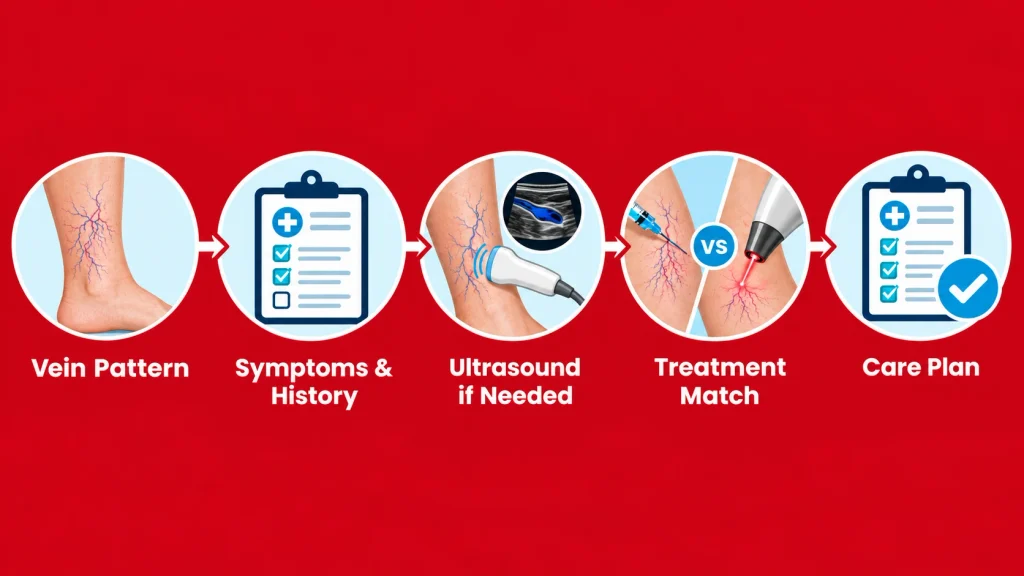
1. Review the Veins: The clinician looks at the location, size, color, pattern, and extent of the visible leg veins.
2. Review Symptoms and History: The team asks about swelling, heaviness, aching, previous vein treatment, medical history, and treatment goals.
3. Use Ultrasound When Indicated: If symptoms or examination suggest deeper reflux, duplex ultrasound can evaluate vein anatomy, blood flow, and valve function.
4. Choose the Appropriate Treatment: For eligible spider and reticular veins, TVE may recommend compounded sclerotherapy. Larger or deeper refluxing veins may require a different treatment approach.
5. Set Expectations: The team explains the likely number of sessions, aftercare, possible side effects, and what results to expect over time.
| Not Sure Which Spider Vein Treatment Fits Your Veins? Schedule a Vein Evaluation |
Frequently Asked Questions About Sclerotherapy vs. Laser
Is sclerotherapy or laser better for spider veins?
Neither treatment is universally better. For leg spider and reticular veins, sclerotherapy is commonly used as a first-line option, while surface laser can be useful for selected very small superficial vessels or when injections are not suitable.
Is sclerotherapy better for spider veins on the legs?
Sclerotherapy has strong guideline support for lower-extremity spider and reticular veins and is commonly used for leg veins. The right treatment still depends on vessel size, location, depth, skin characteristics, previous treatment, and patient-specific factors.
Does laser work on leg spider veins?
Yes. Surface laser treatment can close selected small superficial vessels. It can be especially useful for very tiny veins, but it is not the same as endovenous laser ablation for larger refluxing veins.
Which treatment hurts more, laser or sclerotherapy?
Discomfort varies. Sclerotherapy can cause a brief needle pinch, stinging, or cramping. Surface laser may feel like heat or snapping against the skin. Research has not established a consistent pain advantage for one treatment in every patient.
How many sclerotherapy sessions are needed for spider veins?
TVE notes that many patients receive one or two sessions, although additional treatment may be recommended depending on the number, severity, and distribution of the veins.
Can laser treat veins that are too small for sclerotherapy?
Surface laser can be useful for very small superficial vessels that are difficult to inject. Whether it is appropriate depends on vessel size, location, skin characteristics, and the clinician’s assessment.
Does Texas Vein Experts offer laser treatment for spider veins?
TVE’s current treatment lineup includes compounded sclerotherapy, radiofrequency ablation, VenaSeal, and Varithena. Surface laser is discussed here for comparison but is not listed among TVE’s four current treatment options.