

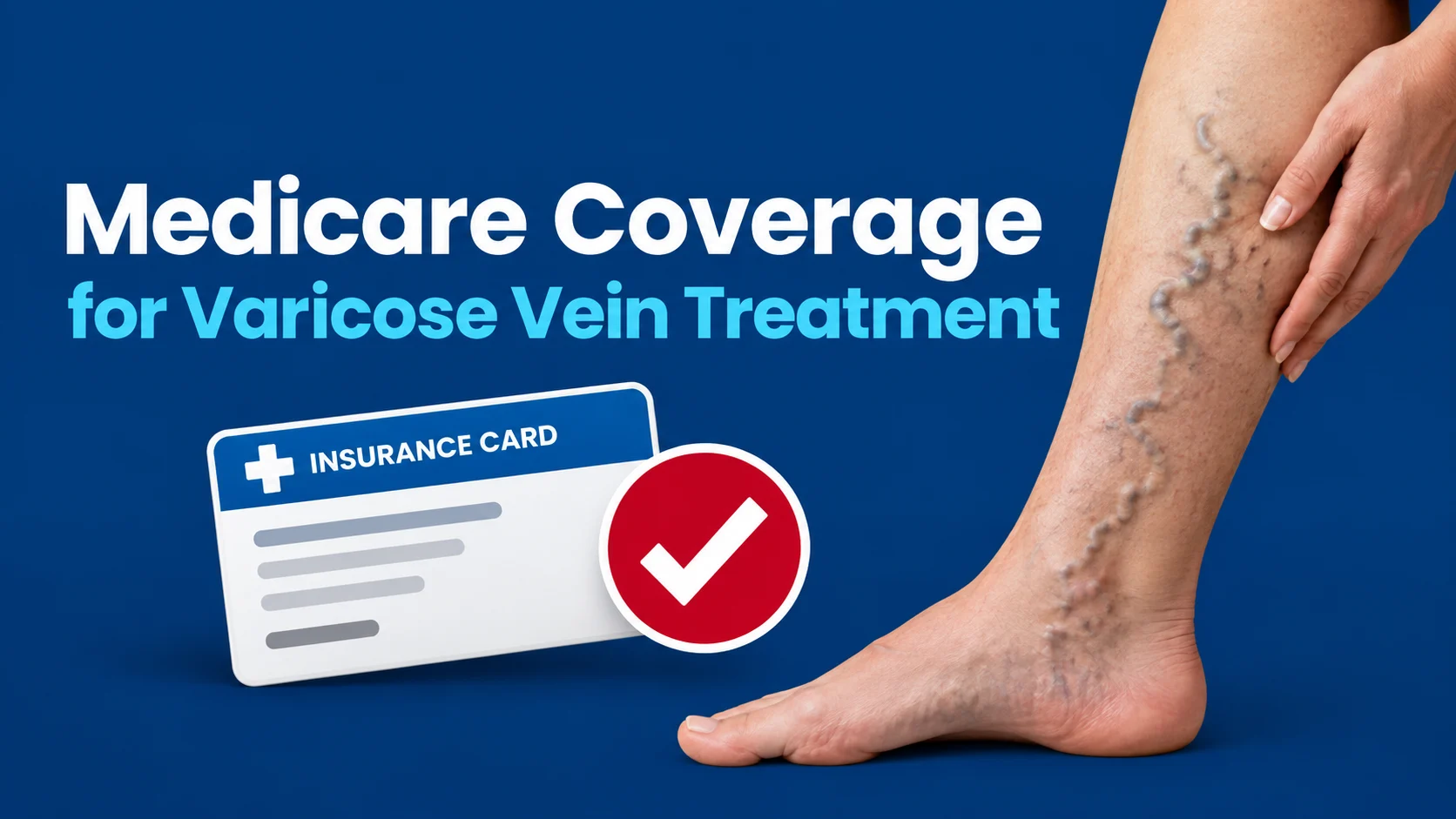
Yes, Medicare may cover varicose vein treatment when it is medically necessary and the applicable coverage requirements are met. Treatment performed only for cosmetic reasons generally does not qualify for Original Medicare coverage. For patients in Texas, Original Medicare claims are processed under Novitas Solutions, and the current local policy for chronic venous insufficiency sets specific documentation, ultrasound, symptom, and treatment-planning requirements.
At Texas Vein Experts, a vein evaluation and duplex ultrasound can help determine whether symptoms are related to venous reflux and which treatment option may be appropriate. Our team can also review available insurance coverage and explain known plan requirements before treatment. Benefits verification is helpful, but it does not guarantee payment.
Coverage note: Medicare rules can vary by location and plan type. This guide focuses on current Original Medicare requirements that apply in Texas and provides general information about Medicare Advantage and Medigap. Individual claims remain subject to the applicable policy and plan rules.
When Does Medicare Cover Varicose Vein Treatment?
The central question is medical necessity. Original Medicare may cover treatment when documented venous disease is causing clinically significant symptoms or complications and the patient meets the applicable local coverage criteria. Appearance concerns alone generally do not make a vein procedure medically necessary.
Examples of findings that may support a medically necessary evaluation include persistent pain or burning, heaviness, swelling, skin changes, ulceration, bleeding, or recurrent superficial inflammation. Having one symptom does not automatically mean treatment is covered. The clinical examination, severity assessment, duplex findings, and treatment plan must support the claim.
If you are unsure whether visible varicose veins are primarily cosmetic or part of symptomatic vein disease, an evaluation can help clarify the difference.
What Does Original Medicare Require for Varicose Vein Treatment in Texas?
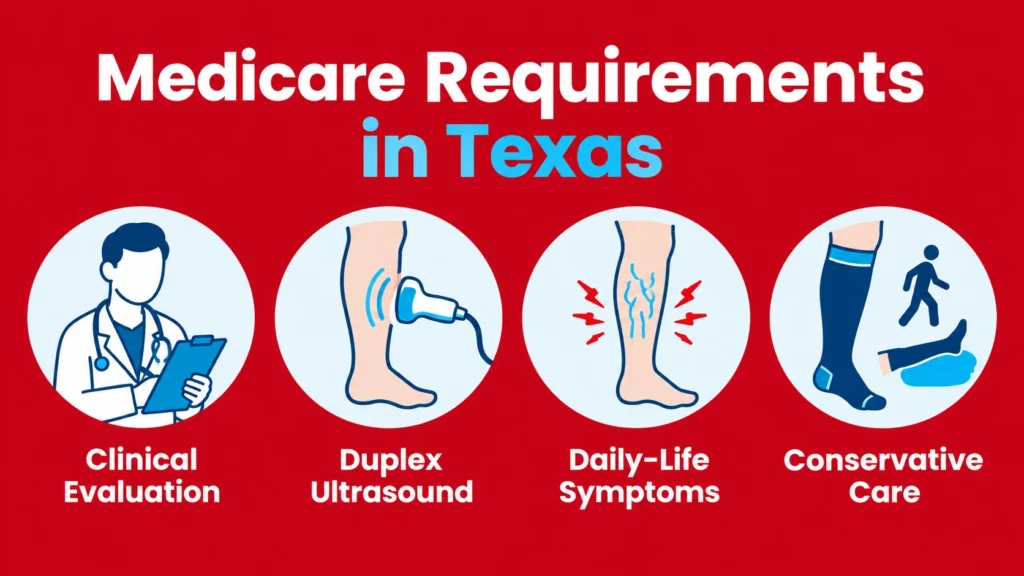
Texas is in Medicare Administrative Contractor Jurisdiction H, where Novitas Solutions administers the current Local Coverage Determination L34924 for treatment of chronic venous insufficiency of the lower extremities. For invasive varicose vein procedures, the policy requires a documented plan of care based on the physician’s evaluation.
1. A Documented Clinical Evaluation
The minimum evaluation includes a medical history, physical examination, the CEAP clinical classification, and the Venous Clinical Severity Score (VCSS). These are clinical tools used by the treating team to describe the type and severity of venous disease. Patients do not need to calculate these scores on their own.
2. Duplex Ultrasound of the Deep and Superficial Veins
The current Texas policy requires duplex ultrasound findings that support the examination. For qualifying saphenous or perforator disease, the policy specifies documented reflux of 500 milliseconds or greater with provocative maneuvers and the absence of deep venous obstruction. The ultrasound also helps the vein specialist identify the affected vein and select an appropriate treatment plan.
3. Symptoms That Affect Daily Life or Quality of Life
Documentation must support signs or symptoms that interfere with activities of daily living or quality of life. This requirement helps distinguish medically necessary vein treatment from a procedure performed only to change the appearance of visible veins.
4. Conservative Treatment When the Policy Requires It
For some patients with CEAP C2 or C3 disease and a VCSS below 6, the current Novitas policy requires documentation of a 2- to 4-week period of conservative therapy before an invasive procedure. The plan may include graduated compression of at least 20-30 mmHg, walking, leg elevation, and avoiding prolonged sitting or standing.
The policy allows the mandatory conservative period to be waived in certain higher-severity situations, including VCSS 6 or greater, CEAP C4-C6 disease, hemorrhage, or recurrent superficial thrombophlebitis. This is why a generic statement that every Medicare patient must complete three months of compression therapy is not accurate for the current Texas policy.
Does Medicare Require Compression Stockings Before Vein Treatment in Texas?
Not every Medicare patient in Texas has the same compression requirement. Under the current Novitas policy, the 2- to 4-week conservative-care requirement applies specifically to certain C2 or C3 patients with a VCSS below 6. The required plan includes graduated compression of at least 20-30 mmHg along with ambulation, elevation, and avoiding prolonged sitting and standing.
For patients who meet the policy’s waiver criteria, mandatory conservative therapy before the invasive procedure may not be required. The treating physician documents the disease severity, clinical findings, prior care, and plan of treatment.
Which Varicose Vein Treatments May Medicare Cover?
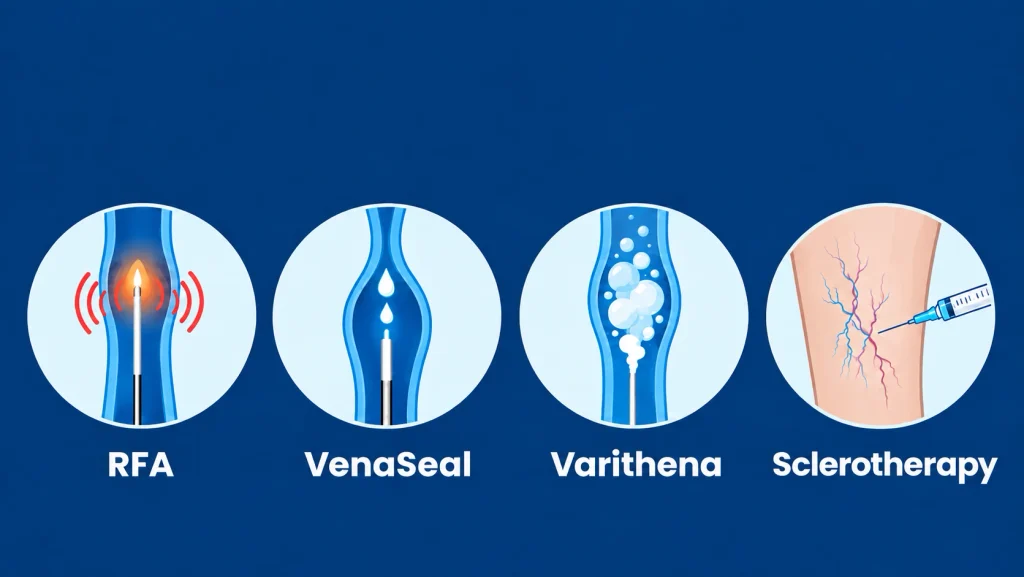
The Texas Medicare policy addresses several categories of treatment for chronic venous insufficiency. Coverage for a specific procedure still depends on whether the patient and the planned treatment meet all applicable requirements. Texas Vein Experts offers four minimally invasive treatment options, and the appropriate choice depends on the vein anatomy, symptoms, duplex findings, medical history, and coverage requirements.
| Treatment | Medicare Policy Category | Coverage Context |
| Radiofrequency Ablation (RFA) | Thermal ablation | The LCD addresses radiofrequency ablation as an endovenous thermal treatment for qualifying refluxing veins. |
| VenaSeal | Chemical adhesive closure | The LCD addresses cyanoacrylate/chemical adhesive closure for eligible refluxing saphenous veins. |
| Varithena | Non-compounded prescription microfoam | The LCD addresses non-compounded foam treatment for qualifying symptomatic venous disease; individual coverage still depends on the claim and plan requirements. |
| Compounded Sclerotherapy | Physician-compounded foam or liquid sclerotherapy | The LCD addresses qualifying foam and liquid sclerotherapy for specified symptomatic venous disease. |
Learn more about radiofrequency ablation, VenaSeal, Varithena, and sclerotherapy. A treatment page explains how a procedure works; Medicare coverage still depends on medical necessity and the applicable plan requirements.
Does Medicare Cover Spider Vein Treatment?
Cosmetic spider vein treatment is generally not covered by Original Medicare. Under the current Texas Novitas policy, CEAP C1 telangiectasias and reticular veins are considered cosmetic except in limited circumstances involving spontaneous or traumatic venous hemorrhage.
That is different from medically necessary treatment of symptomatic varicose veins or underlying venous insufficiency. If you are comparing cosmetic self-pay care, our upcoming guide to spider vein removal cost can provide additional context once published.
Does Medicare Part B Cover Varicose Vein Treatment?
Medicare Part B covers approved outpatient medical and surgical services. When a varicose vein procedure is medically necessary and meets the applicable coverage requirements, the physician and outpatient services may fall under Part B.
For 2026, the Medicare Part B annual deductible is $283. After the deductible, beneficiaries generally pay 20% of the Medicare-approved amount for covered doctor or other health-care-provider services. Other costs can apply depending on the treatment setting, whether the provider accepts assignment, and other insurance you may have.
The Medicare-approved amount is not the same as a clinic’s published cash price. Patient responsibility depends on the covered service, Medicare payment rules, the care setting, and any secondary coverage.
Does Medicare Advantage Cover Varicose Vein Treatment?
Medicare Advantage plans must cover the medically necessary services that Original Medicare covers, but the way you receive that coverage can differ by plan. A Medicare Advantage plan may use provider networks, prior authorization, referral rules, and its own copays or coinsurance.
Before treatment, confirm whether the vein specialist and facility are in network, whether prior authorization is required, and what your expected patient responsibility may be. Texas Vein Experts can provide insurance benefits verification and explain known plan requirements, although benefits verification is not a guarantee of payment.
Can Medicare Supplement Insurance Help With Vein Treatment Costs?
A Medicare Supplement Insurance policy, also called Medigap, may help pay some Original Medicare cost sharing depending on the standardized plan you have. Many Medigap plans cover all or part of Part B coinsurance, while benefits and eligibility differ by plan. Medigap does not replace Medicare’s medical-necessity requirements for the procedure itself.
What Might You Pay if Medicare Covers Your Vein Treatment?
Your out-of-pocket cost can depend on whether you have Original Medicare, Medicare Advantage, or supplemental coverage. The treatment itself, the care setting, and other covered services can also affect patient responsibility.
| Coverage Type | General Cost Context |
| Original Medicare Part B | 2026 deductible of $283, then generally 20% of the Medicare-approved amount for covered provider services; other costs may apply. |
| Medicare Advantage | Plan-specific copays, coinsurance, networks, and prior authorization can affect what you pay. |
| Original Medicare + Medigap | A Medigap policy may pay some Original Medicare cost sharing depending on the plan. |
| Cosmetic / noncovered care | If Medicare does not cover the service, the patient may be responsible for the full cost. |
For broader pricing information, see our upcoming guide to varicose vein treatment cost once it is published. That article focuses on general treatment-cost benchmarks, while this guide focuses specifically on Medicare coverage rules.
How Can Texas Vein Experts Check Your Medicare Benefits?
The most accurate answer comes after the clinical findings and recommended treatment are known. Texas Vein Experts uses a step-by-step process to connect the diagnosis, treatment plan, and insurance requirements.
1. Consultation: The team reviews your symptoms, medical history, previous vein treatment, medications, mobility, and how the condition affects daily life.
2. Clinical Examination: A provider evaluates visible varicose veins, swelling, skin changes, tenderness, and other findings that may support the medical-necessity assessment.
3. Duplex Ultrasound: TVE performs onsite ultrasound to map venous reflux and document the deep and superficial venous systems. Same-day results help guide the next step.
4. Personalized Treatment Plan: The physician determines whether RFA, VenaSeal, Varithena, compounded sclerotherapy, or another plan is appropriate for the documented anatomy and symptoms.
5. Benefits and Authorization Review: TVE can verify available Medicare or Medicare Advantage benefits and identify known authorization or network requirements when applicable.
6. Expected Patient Responsibility: Once the treatment and coverage pathway are defined, the team can explain the available cost information and next steps.
Texas Vein Experts has vein clinic locations across Texas serving DFW, Houston, and the San Antonio market.
| Need Help Understanding Medicare Coverage for Vein Treatment?Schedule a Vein Evaluation | Review Insurance Options |
Frequently Asked Questions About Medicare and Varicose Vein Treatment
Does Medicare cover varicose vein treatment?
Medicare may cover varicose vein treatment when it is medically necessary and the applicable coverage requirements are met. In Texas, Original Medicare claims are subject to the current Novitas Solutions policy for chronic venous insufficiency. Cosmetic treatment generally does not qualify.
Does Medicare Part B cover varicose vein treatment?
Part B can cover approved outpatient medical and surgical services when the procedure is medically necessary and meets Medicare coverage rules. In 2026, the Part B deductible is $283, and beneficiaries generally pay 20% of the Medicare-approved amount for covered provider services after the deductible, although other costs may apply.
Does Medicare cover radiofrequency ablation for varicose veins?
The current Texas Medicare policy addresses radiofrequency ablation as a thermal treatment for qualifying venous disease. Coverage depends on the documented symptoms, duplex findings, disease severity, plan of care, and other policy requirements.
Does Medicare cover sclerotherapy for varicose veins?
The Texas policy addresses qualifying foam and liquid sclerotherapy for specified symptomatic venous disease. Cosmetic sclerotherapy for spider veins is generally not covered unless the limited C1 hemorrhage exception in the policy applies.
Does Medicare cover spider vein treatment?
Original Medicare generally considers treatment of C1 telangiectasias or reticular veins cosmetic in Texas, except in limited cases involving spontaneous or traumatic venous hemorrhage.
Does Medicare require compression stockings before vein treatment in Texas?
Not for every patient. The current Novitas policy requires 2-4 weeks of conservative therapy for certain C2-C3 patients with VCSS below 6. The mandatory period may be waived for higher-severity disease, hemorrhage, or recurrent superficial thrombophlebitis.
Does Medicare Advantage cover varicose vein treatment?
Medicare Advantage plans must cover the medically necessary services that Original Medicare covers, but the plan may use its own network, prior-authorization, referral, and cost-sharing rules. Verify the specific plan before treatment.